
Please read the important information regarding these games at the bottom of the page.

    20:39     
      
 
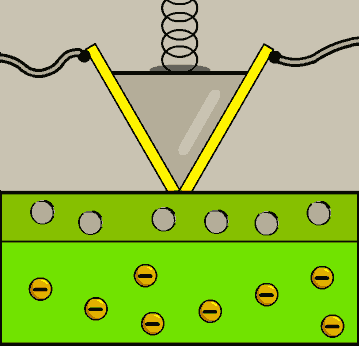
In the beginning, the scientists tried to place two ordinary metal contacts on the surface of the germanium crystal. The problem was to bring these contacts sufficiently close to each other, to obtain the transistor effect. The contacts needed to be within a few hundredths of a millimetre, about the thickness of a paper, and this was very hard to achieve with conventional metal wire contacts. With the use of the two point-contacts created by the slit in the gold foil, the contacts could be placed within a distance of 0.05 mm of each other.


To cite this page
MLA style: "The Transistor". Nobelprize.org. Nobel Prize Outreach AB 2021. Web. 5 Jun 2021. <http://educationalgames.nobelprize.org/educational/physics/transistor/function/pointcontact_2.html>

About the educational games

The educational games are based on Nobel Prize awarded discoveries and were produced between 2001 and 2012. The games have not been updated since production (including potential scientific facts changes) and are provided here on an 'as is' basis by popular demand.

Some of the games run using Ruffle without the need of any plugin, but most of the games still require Adobe Flash Player. Flash is an old technology that has reached end of life. These games will no longer work without a dedicated setup. If you are depending on these games in your profession, please advice your local IT support. We do not have the resources to provide support.

We are working on supporting other games using Ruffle as well. We also hope to publish a new version of the Blood typing game, our most popular game, in mid-2021.