Export Proteins
Some proteins involved in the
translocation of mRNA through the nuclear pore »
Adaptors as export
signals:
Substances, like mRNA, that are transported from the
nucleus to the
cytoplasm, contain an export signal that serves as a
label saying "I should be transported to the
cytoplasm". The label is recognized by export
receptors. It is probably not the mRNA itself, but
rather proteins associated with the mRNA, which are
recognized by the export receptors. For example, some
common proteins associated with mRNA (like HnRNP A1
and HnRNP K) have been shown to contain export
signals.
Also the proteins associated
with the 5' end
CAP of the mRNA
(called
Cap Binding Complex
CBC) acts as export signal. They are not crucial for
the transport of mRNA, but may play a role in the
directional translocation since the 5' end of the
mRNA is transported in the lead.
Export receptors:
Export receptors bind to the export signals and carry
the cargo (the mRNA) to the other side of the nuclear
pore complex. In the case of mRNA transport, an
export receptor called CRM1 is believed to be
important.
Directional transport:
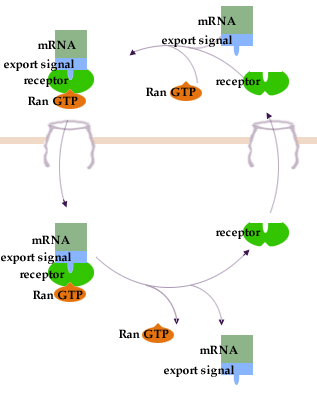
In order for the export protein to bind to the export
signal on the cargo, a protein called RanGTP is
needed. The whole complex (the mRNA with the proteins
acting as export signals, the export receptor and
RanGTP) is transported together through the nuclear
pore complex, from the
nucleus to the
cytoplasm. In the cytoplasm, the complex
disassociates and in this process RanGTP is
hydrolized to RanGDP. The receptors are then recycled
to the nucleus.
mRNA may only be transported
from the
nucleus to the
cytoplasm and not
in the other direction. The assymetry of
RanGTP/RanGDP is thought to be one important factor
of this directional transport of mRNA.
|